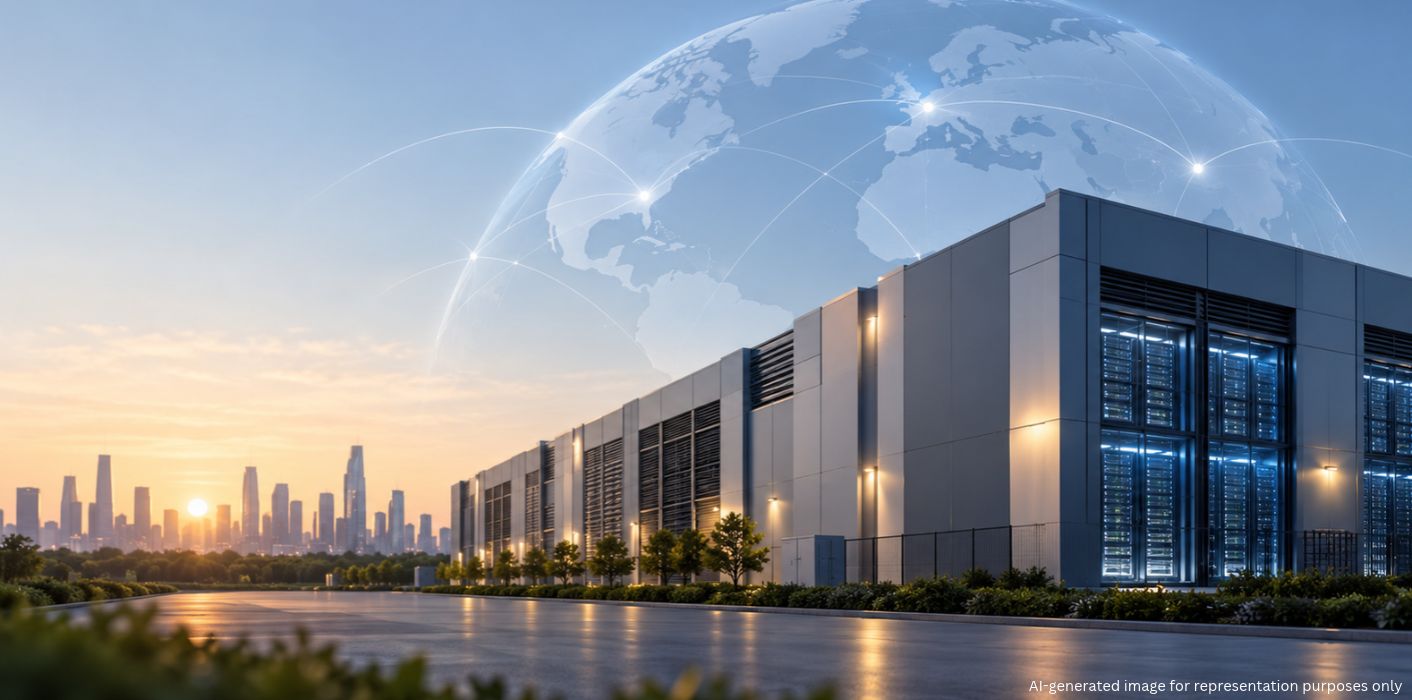
The growth of artificial intelligence is creating a major infrastructure story beyond software and semiconductors. The AI data centre real estate opportunity is becoming increasingly significant as businesses, cloud providers and AI developers require large amounts of specialised computing capacity. McKinsey estimates that AI may represent about 70% of worldwide data centre capacity demand by 2030, while total global data centre requirements could involve nearly $7 trillion in capital spending. JLL estimates that real estate could represent around $3 trillion of that investment over the next five years.
Data centres have become an important part of commercial real estate because digital services depend on physical facilities for computing, storage and connectivity. Their role covers much more than AI, with cloud platforms, enterprise technology and internet services also requiring dedicated capacity.
This creates a property market where location, power availability and infrastructure access are closely connected to technology demand.
Data centre operators serve customers with specific geographic and operational requirements. Digital Realty has facilities across Northern Virginia, Dallas, Chicago, Singapore, Tokyo, Frankfurt and Amsterdam, giving it access to major technology markets across several regions.
The company has reported sustained demand exceeding available supply in these markets. Customers also compete for the same facilities because their workloads often require particular locations rather than unrestricted placement anywhere.
Its international footprint supports another important requirement: data sovereignty. Businesses operating across countries need infrastructure that meets local data requirements while also providing appropriate customer support.
The next stage of the AI infrastructure story is closely linked to how frequently people and businesses use AI applications.
The Jones Lang LaSalle (JLL), a global commercial real estate services and investment management company identifies AI inference as a major source of future demand. Inference refers to the computing process used when trained AI systems respond to requests and perform tasks.
Daily AI adoption also has room to expand. JLL notes that only one in four Americans currently use AI every day. Wider use of AI tools within business processes and everyday activities therefore represents another source of data centre capacity requirements.
This demand exists alongside continued growth in cloud computing and broader digital transformation.
The financial commitment to data centre infrastructure can be seen in Digital Realty's development activity. Its pipeline of projects under construction has reached $20 billion, twice the $10 billion reported at the end of 2023.
The company has also developed a broader approach to financing its capital-intensive operations. This includes private capital, individual joint ventures and a balance sheet positioned with high liquidity and lower leverage.
These funding methods allow data centre development to be supported through multiple capital sources rather than relying entirely on the company's own balance sheet.
The scale of the opportunity has also attracted major institutional investors. JLL's research identifies Blackstone, BlackRock and KKR among institutions with strong conviction in the data centre sector.
Their participation reflects the growing importance of digital infrastructure within commercial real estate portfolios. The sector now connects technology requirements with property development, long term infrastructure investment and specialised facilities.
The AI data centre real estate opportunity represents one part of a much larger digital infrastructure market. AI development, cloud computing, enterprise IT, internet services and the growing use of AI applications all contribute to demand for physical capacity.
McKinsey's projection of nearly $7 trillion in global data centre capital spending by 2030, combined with JLL's approximately $3 trillion real estate estimate over five years, shows the scale of the property opportunity.
For the real estate industry, data centres have therefore become a major link between technological expansion and physical infrastructure investment.