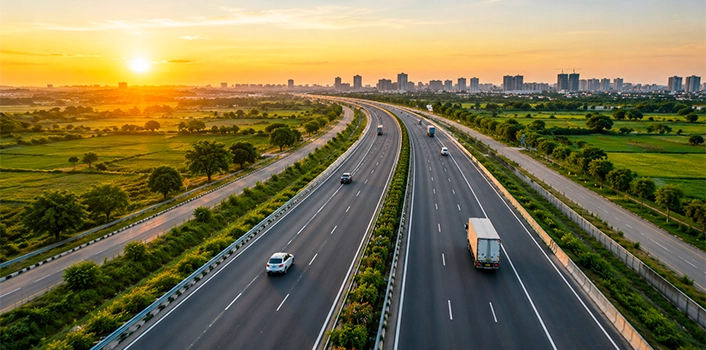
India's National High-Speed Corridor programme is moving into a new phase, with a substantial share of the planned network already operational. According to the Ministry of Road Transport and Highways, 4,809 km of the 10,389 km of awarded high-speed corridors and Greenfield Expressways have been completed, while 5,580 km remain under construction. This expanding network is strengthening freight movement, reducing travel time and influencing investment across industrial and real estate markets.
The latest figures presented in Parliament show that around 46% of the awarded high-speed corridor network has been completed. The remaining projects are progressing through different construction stages under regular monitoring by project authorities, state governments and the Centre.
State-wise progress highlights include:
| State | Awarded | Completed |
| Rajasthan | 1,340 km | 1,192 km |
| Punjab | 923 km | 149 km |
| Andhra Pradesh | 893 km | 308 km |
| Uttar Pradesh | 884 km | 388 km |
| Haryana | 839 km | 615 km |
| Gujarat | 764 km | 605 km |
Several states including Bihar, West Bengal, Jharkhand, Jammu and Kashmir, Assam and Himachal Pradesh are yet to commission their first operational stretches, indicating that corridor expansion is still geographically uneven.
High-speed corridors reduce travel time between cities, industrial zones, logistics hubs and ports. This changes how businesses evaluate land and where residential and commercial development takes place.
For the real estate sector, improved highway connectivity typically supports:
Areas located along completed corridors often become more attractive for long-term development as accessibility improves.
India's logistics costs remain higher than many manufacturing economies. High-speed corridors are designed to improve freight efficiency by reducing congestion and providing faster access-controlled routes between major economic centres.
Lower travel times can help businesses through:
These factors are particularly important for manufacturing, e-commerce, agriculture and export-oriented industries.
The government has introduced several measures to reduce delays in highway execution, including:
With more than 5,500 km of high-speed corridors still under construction, India's highway network is set for significant expansion over the next few years. For the real estate sector, the biggest opportunities are likely to emerge in locations where new corridors improve regional connectivity before property markets fully adjust. Developers, investors and businesses tracking infrastructure-led growth will increasingly look beyond established cities toward emerging highway-linked corridors as construction progresses.
1. How many high-speed highway corridors have been completed in India?
India's National High-Speed Corridors and Greenfield Expressways have completed 4,809 km out of the 10,389 km awarded across the country. The remaining 5,580 km are currently under construction, according to the Ministry of Road Transport and Highways.
2. Which state has the highest completed high-speed highway network in India?
Rajasthan's National High-Speed Corridor network has the highest completed length in the country, with 1,192 km operational out of 1,340 km awarded. It currently leads all states in completed high-speed highway infrastructure.
3. How do high-speed highway corridors affect real estate development?
India's National High-Speed Corridor programme improves connectivity between cities, industrial hubs and logistics centres, making nearby locations more attractive for residential, commercial and industrial projects. Better road access also supports long-term investment and regional development.
4. What steps is the government taking to speed up highway construction?
India's National High-Speed Corridor programme is being accelerated through digital land acquisition using the Bhoomi Rashi portal, faster environmental approvals via the Parivesh portal, GIS-based planning and online railway bridge approvals. These measures are intended to reduce project delays and improve execution.
5. Why are high-speed highway corridors important for India's economy?
India's National High-Speed Corridor network helps reduce travel time, improve freight movement and strengthen connectivity between major economic centres. These improvements support lower logistics costs, faster supply chains and increased business activity across multiple sectors.